As the automotive industry continues to evolve, manufacturers like us need to evolve with it. For Sun Filter, that has meant not only developing quality products, but also continuously improving the way we manufacture, manage and deliver them. One important step in that journey came when we joined a logistics development programme run by Thailand’s Department of Industrial Promotion. What began as an effort to tackle inventory challenges ultimately changed the way we thought about production and warehouse management.
Today, we manufacture a wide range of filtration products under our FIL brand, including oil filters, air filters, fuel filters, hydraulic filters and cabin air filters. Our range covers passenger cars, trucks, agricultural vehicles, big bikes, boats and heavy machinery. With more than 500 products, FIL has grown from a Thai filter brand into one serving customers both at home and internationally, with our products exported to more than 30 countries worldwide.
From a Thai Manufacturer to an International Brand
Our journey began in 1995, before Sun Filter was formally registered in 1997. By 2001, we had already created our own brand and were beginning to build the foundations for FIL. Over the years, we continued to strengthen our standards and capabilities, becoming one of the early Thai companies in our field to achieve ISO 9001 certification as well as Thai Industrial Standards certification. Our work has since been recognised through the Thailand Brand programme, which later became the Thailand Trust Mark, as well as the Prime Minister’s Export Award and other awards relating to management and quality. But as our product range and business grew, so did the complexity behind the scenes.
The Growing Pains Behind Our Warehouse
In our earlier years, we did not have the structured warehouse system we have today. Products could be stored wherever space happened to be available. We originally followed a FIFO, or “first in, first out”, approach, with newly manufactured products placed behind existing stock so that older products could be used first. While the principle was sound, our products were organised according to production lots rather than individual SKUs. As our range expanded, this made it increasingly difficult for our team to locate and manage hundreds of different products efficiently.
We eventually found ourselves facing two problems at the same time: some slower-moving products were filling our warehouse, while some of our best-selling products were regularly out of stock. Even more challenging, the products affected were not necessarily the same from one month to the next. We needed a better understanding of what to produce, how much to produce and where everything should go.
Rethinking What Logistics Means
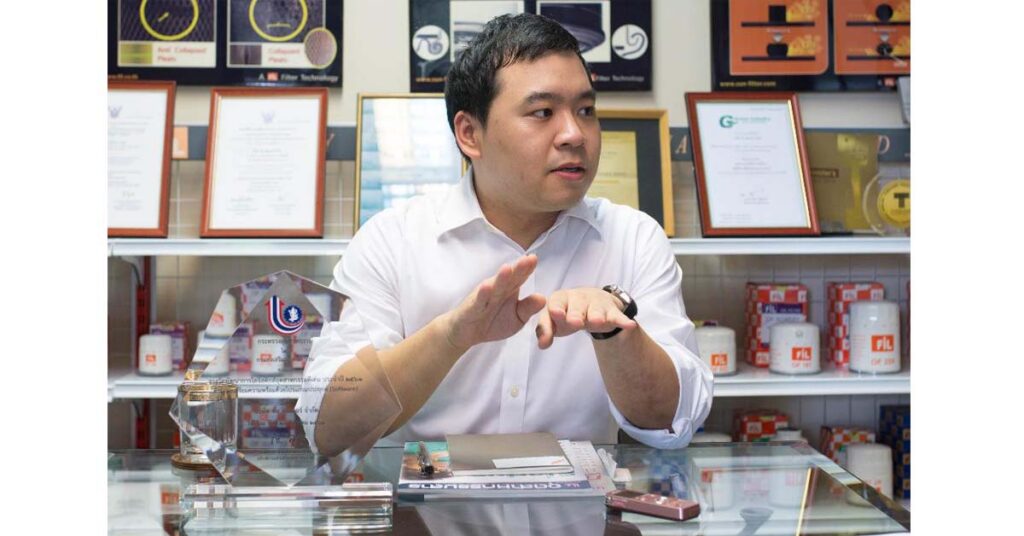
In 2018, we joined the Department of Industrial Promotion’s programme to improve SME capabilities through logistics software and hardware. At first, we were not entirely convinced that logistics was the answer. As Kanate Ratapipat, Chief Operating Officer of Sun Filter Co., Ltd., recalls:
“Before joining, I actually asked why we needed a logistics programme. We weren’t a logistics business and we didn’t even handle deliveries ourselves. We outsourced them.”
Our perspective changed after working with Asst. Prof. Dr. Paitoon Siri Oran of Panyapiwat Institute of Management. At the time, excess inventory was one of our biggest challenges. When Kanate explained that the solution was simply to try to sell the excess stock, Asst. Prof. Dr. Paitoon raised a different question: what if we prevented the excess stock from being created in the first place? That conversation changed the way we looked at logistics. It was not simply about moving products from one place to another. It was about managing the entire flow of products more intelligently, from production planning through to storage and availability.
Producing the Right Products at the Right Time
From there, we began improving three main areas of our operations. First, we changed the way we planned production. Rather than producing similar quantities across our range, we could manufacture fewer units of slower-moving products and more of the products our customers needed most, while also aligning production schedules more closely with our export cycles. Second, we improved the way we managed individual SKUs. Third, we began using data more effectively to guide our production and inventory decisions.
With support from Asst. Prof. Dr. Paitoon Siri Oran, we introduced the “Mini Thep” programme to help us plan production and stock levels. This gave us a clearer picture of seasonal demand across individual products, allowing us to increase or reduce production at different times of the year based on what the market actually needed. Instead of reacting to excess stock or shortages after they occurred, we could plan ahead and make better use of our production capacity.
Rebuilding Our Warehouse System
Improving our processes also meant going back to basics. Under Asst. Prof. Dr. Paitoon’s guidance, we went through every box in our warehouse and reorganised our stock from the ground up. The process uncovered products that had effectively been forgotten. Some existed in our inventory records but had become difficult to locate because they were hidden behind other stock, while others had been stored for so long that they had become damaged.
So we redesigned the way our warehouse worked. One of the simplest improvements turned out to be one of the most useful: creating a warehouse map. With a clear location system, our team could identify where a product was stored and when it had been manufactured. Staff no longer had to rely on a supervisor who happened to know where a particular item was located. The result was a warehouse that was easier to navigate, quicker to operate and less prone to mistakes.
Managing Inventory More Intelligently
We also introduced an ABC inventory management system, grouping our products according to their importance and demand. Category A covers finished products that should always be available, while Category B products can temporarily be out of stock for up to one week. Category C products can be manufactured when spare production capacity is available. At the time, Category C represented only around 5% of our revenue, so this approach allowed us to focus our production resources where they could make the greatest difference.
By matching production more closely with demand, we were able to reduce the risk of missed sales caused by unavailable stock, representing an estimated value of THB 3.4 million. More importantly, the new approach gave us a much clearer way to balance customer demand, production capacity and the amount of inventory we needed to hold.
Always Looking for a Better Way
The lessons from this project went far beyond warehouse organisation. They reinforced something that remains important to us today: growth is not simply about producing more. It is about finding better ways to work. As competition continues to grow, maintaining high standards in both product quality and customer service remains fundamental to our business. At the same time, we continue to look for opportunities to innovate, improve our processes and develop higher-value products for a changing automotive industry.
The technology may change and the market may move quickly, but the principle remains the same: keep learning, keep improving and never stand still. As Kanate puts it:
“The world is moving quickly, so we cannot afford to stand still. The new generation of SMEs need to keep learning, keep improving and have the determination to move forward.”